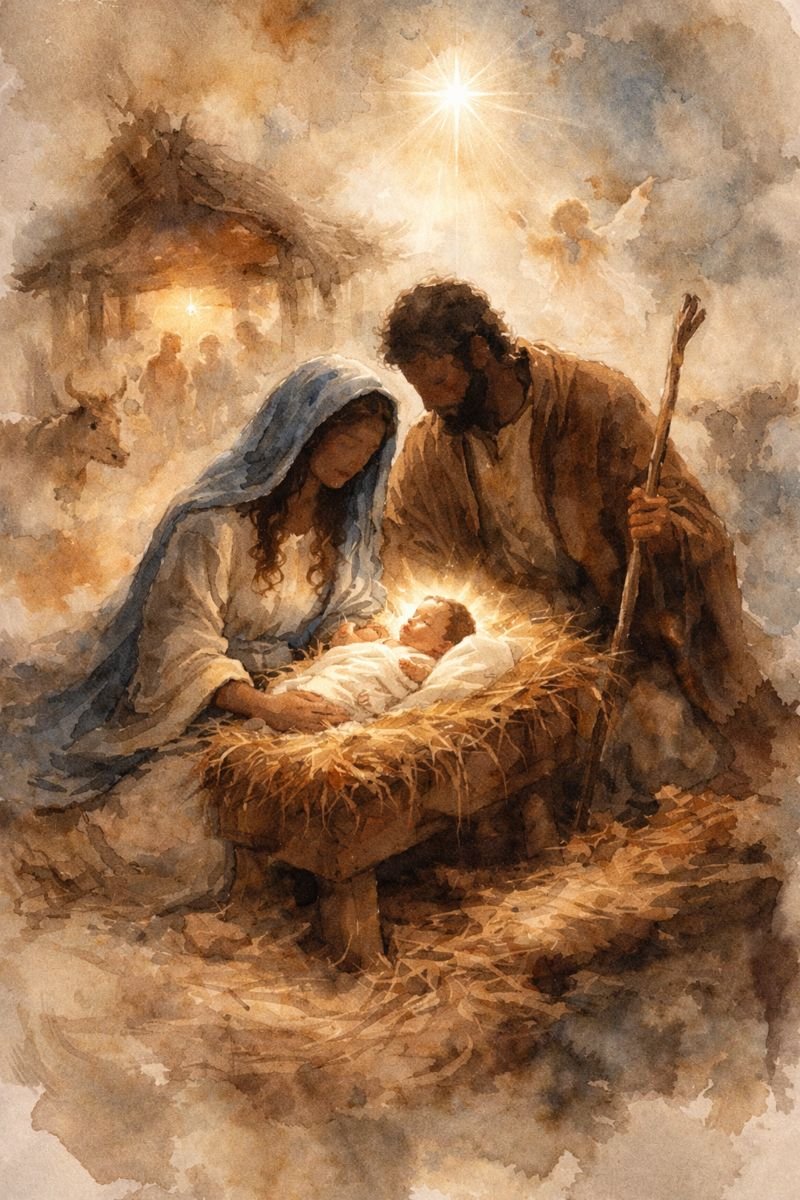
The Incarnation of Jesus
I was sitting alone in my small office at the church, trying to write something before Christmas, when I found myself stuck. I kept thinking, What could I possibly write about that hasn’t already been written about? The truth is, I can’t. As Ecclesiastes reminds us, there is nothing new under the sun. What could I say that hasn’t already been said, and likely said far better than I could ever say it?
But then I was reminded of something. In a recent conversation, someone asked me what my favorite Bible verse was. My answer surprised even me. I said, “I don’t think I can pinpoint just one overall. Different parts of Scripture speak to us in different seasons of life, and they do so with varying weight and clarity depending on where we are.” I believe the same is true of theological reflection.
Yes, far more intelligent people than I have written about the birth of Christ, often with depth and beauty I can only admire. But at this moment, perhaps God is pleased to use this reflection, this time, and this voice to draw our attention back to a doctrine we may have quietly taken for granted.
We have accepted it.
We have affirmed it as true.
But many of us have not truly wrestled with it, lingered over it, or pondered its significance since the day we first believed, if ever at all.
So today, I want to offer a brief refresher on the incarnation.
Not as a seasonal sentiment, but as a doctrine central to our understanding of who God is, and to what it means that He took on flesh for us.
What is the Incarnation?
The incarnation is the Christian belief that God, in the person of Jesus Christ, the eternal Son of God, took on human flesh. Without ceasing to be fully divine, He became fully human, entering our world in order to dwell among us, reveal the true nature of God, and accomplish our salvation.
While the incarnation is most visibly celebrated during the Christmas season, it is not a doctrine reserved for December alone. It is a truth meant to shape the whole of the Christian life. We must cherish it daily, because it is the foundation upon which our hope rests. Without the incarnation, there is no atonement; without the incarnation, there is no reconciliation. It is precisely because God the Son took on flesh that wretched sinners like us can be freed from the penalty and power of sin through the perfect life, obedient death, and victorious resurrection of Jesus Christ.
In the incarnation, God quite literally writes Himself into the story of humanity. He does not remain distant, issuing commands from afar, nor does He merely provide us with a moral example to imitate in our own strength. Instead, He comes near. He assumes our nature, enters our brokenness, and gives us something far greater than an example, He gives us a new heart. A heart made alive by grace, attuned to follow Him, and capable of loving God because God first loved us.
Why the Incarnation Is Necessary (Not Merely Beautiful)
Few have written about the incarnation more clearly or more forcefully than one of the early Church Fathers, Athanasius of Alexandria. In On the Incarnation, he observes that humanity was faced with two problems that were, by all human standards, insoluble.
First, corruption and death: The natural consequence of turning away from the Source of life.
Second, guilt before God: The moral and covenantal consequence of human transgression.
Why was this such a problem? Because no created being could ever resolve either of these realities. Only God can defeat death. Yet only man ought to pay the debt of man. Humanity stood condemned and decaying, unable to save itself and incapable of restoring what had been lost.
But God.
This is why the incarnation is not an act of divine convenience, but of divine necessity. Athanasius writes, “The Word of God came in His own person, because it was He alone, the Image of the Father, who could recreate man made after the Image.” Salvation required more than instruction; it required restoration. More than forgiveness; it required renewal.
If Christ were merely a moral teacher, death would remain undefeated.
If Christ were a semi-divine intermediary, creation would remain unhealed.
If Christ only appeared to be human, then humanity itself would remain untouched.
Think back to when you were first saved. Do you remember the weight of your sin, the awareness that something was deeply, fundamentally wrong, and that you could not fix it yourself? Only Jesus could bear that weight. Only Jesus could satisfy the righteous wrath of the Father, because He was both perfect man and fully God, God Himself stepping into history. In Christ, God breaks through, crushes the serpent’s head, reconciles sinners to Himself, redeems what was lost, and makes us co-heirs with Him in glory.
Getting the Incarnation Wrong Means Getting God Wrong
Getting the doctrine of the incarnation wrong does not result in a small theological misstep, it reshapes our understanding of who God is altogether.
One of the most common heresies of our age is the belief that Jesus is a created being and therefore not truly God. This line of thinking often appeals to passages such as Matthew 26:36–46, where Jesus prays to the Father in the Garden of Gethsemane. The objection is usually framed this way: “If Jesus is God, how can He be praying to Himself?” Another frequently cited text is Colossians 1:15, where Christ is described as the “firstborn of all creation.” Both arguments arise not from careful biblical theology, but from a fundamental misunderstanding of the incarnation.
Jesus is not praying to Himself, He is praying to the Father. At no point does Jesus claim to be the Father. Rather, He declares, “I and the Father are one” (John 10:30). Unity of essence does not mean sameness of person. In the same way, the Holy Spirit is not the Son, nor is the Son the Spirit. These objections collapse precisely because they ignore the reality that Christians worship a triune God.
The Father is not the Son.
The Son is not the Father.
Neither of them is the Holy Spirit.
Yet all three are fully and eternally God.
This is not a philosophical invention, it is the clear and consistent witness of Scripture.
When Paul refers to Jesus as the “firstborn of all creation” in Colossians 1:15, he is not speaking of Christ as the first thing God made. Rather, he is using covenantal and royal language that refers to preeminence, authority, and inheritance. In the ancient world, the “firstborn” was the heir, the one with supremacy, not necessarily the one born first chronologically. Paul immediately clarifies this in the verses that follow, declaring that all things were created through Him and for Him. A created being cannot be the agent of creation itself.
As the eternal Son, Jesus enjoyed perfect communion with the Father from all eternity. As John writes:
“In the beginning was the Word, and the Word was with God, and the Word was God.”
The Word was with God: Distinct in person.
The Word was God: Identical in essence.
This is the heart of orthodox Christology.
These are only two of the most common modern errors concerning the incarnation, but they demonstrate how quickly doctrinal confusion can open into serious theological chasms. When Christ is diminished, salvation is diminished. When His deity is denied, the cross loses its power. When His humanity is compromised, our redemption is left incomplete.
These particular distortions are not merely academic. They are actively taught today by some of the most visible cults in America. The Church of Jesus Christ of Latter-day Saints teaches that Jesus is the offspring of a “Father God” and the spirit-brother of Lucifer. Jehovah’s Witnesses teach that Jesus is Michael the Archangel, a created being exalted above others. In both cases, Christ is no longer the eternal Son of God who took on flesh for our salvation.
And this is the gravity of getting the incarnation wrong.
But here is the hope: the true doctrine of the incarnation does not leave us with a distant or diminished Savior. It gives us God Himself, come near. Fully God, able to save. Fully man, able to stand in our place. In Jesus Christ, God has not delegated redemption—He has accomplished it. The incarnation assures us that our salvation rests not on a creature, not on a mediator who might fail, but on the eternal Son who cannot.
To get the incarnation right is not merely to win an argument, it is to stand firmly on the only gospel that truly saves.
Why is This Doctrine Imperative Today
The doctrine of the incarnation remains imperative today because every generation faces the temptation to reshape Jesus into something more comfortable, more manageable, or more culturally acceptable. In some circles, He is reduced to a moral teacher whose primary purpose is to affirm our values. In others, He becomes a distant spiritual figure, inspiring but untouchable. Both approaches strip Christ of His glory and rob the gospel of its power. When the incarnation is misunderstood or minimized, salvation quietly shifts from something God accomplishes for us to something we attempt to achieve within ourselves.
The incarnation confronts this tendency head-on. It reminds us that Christianity is not rooted in human ascent toward God, but in divine descent toward humanity. God does not save by offering better advice or stronger motivation; He saves by entering our condition, assuming our nature, and redeeming it from the inside out. A Christ who is not fully God cannot conquer sin and death. A Christ who is not fully man cannot truly represent us. To lose either truth is to lose the gospel itself.
Perhaps most importantly, the incarnation assures believers that God is not distant from their suffering, weakness, or pain. In Jesus Christ, God knows hunger, exhaustion, grief, betrayal, and death, not as an observer, but as a participant. This doctrine does not merely inform our theology; it anchors our hope. Because God has taken on flesh, no aspect of human life is beyond His redeeming reach. The incarnation declares that God has drawn near, and because He has, redemption is not only possible, it is certain.
From Doctrine to Doxology
Athanasius understood something the Church must never forget: the doctrine of the incarnation is not an abstract theological puzzle to be solved, but a truth meant to lead us into worship. He did not defend the incarnation merely to win arguments against heresy; he defended it because the very heart of the gospel was at stake. If Christ is not fully God, then death is not defeated. If Christ is not fully man, then humanity is not redeemed. But because the eternal Word truly became flesh, salvation is not theoretical, it is accomplished.
In the incarnation, we see the astonishing humility of God. The Creator enters His creation. The immortal Son takes on mortal flesh. The Holy One draws near to sinners, not to condemn them, but to save them. This is why Athanasius could speak so confidently of restoration and renewal: in Christ, God does not merely forgive sin, He redeems what sin has broken. The incarnation reveals not only what God has done, but who God is: gracious, patient, merciful, and faithful to His promises.
And this is where doctrine gives way to doxology. Right belief about the incarnation should move us to right worship. We do not marvel at the manger because it is sentimental, but because it is staggering. In Jesus Christ, God has come near. He has entered our darkness, borne our guilt, and secured our redemption. To confess the incarnation rightly is to stand in awe, to bow in humility, and to rejoice with confidence that our salvation rests not on our grasp of God, but on His mighty grasp of us.
Questions for Reflection
How does knowing that Christ is fully God and fully man deepen my confidence in salvation?
In what ways does the incarnation comfort me in suffering, weakness, or doubt?
Does my understanding of Jesus lead me more toward admiration or toward worship?
May you rejoice this Christmas in the wonder that the Word became flesh and dwelt among us.
May the humility of Christ quiet your fears, the nearness of God strengthen your faith,
and the finished work of Jesus fill your heart with lasting hope.
And as you celebrate His birth, may your worship rise, not from sentiment alone,
but from a deep confidence that God has come near to save His people.
Grace and peace to you,
this Christmas and always.